Peer-to-peer technology
What Does P2P Mean?
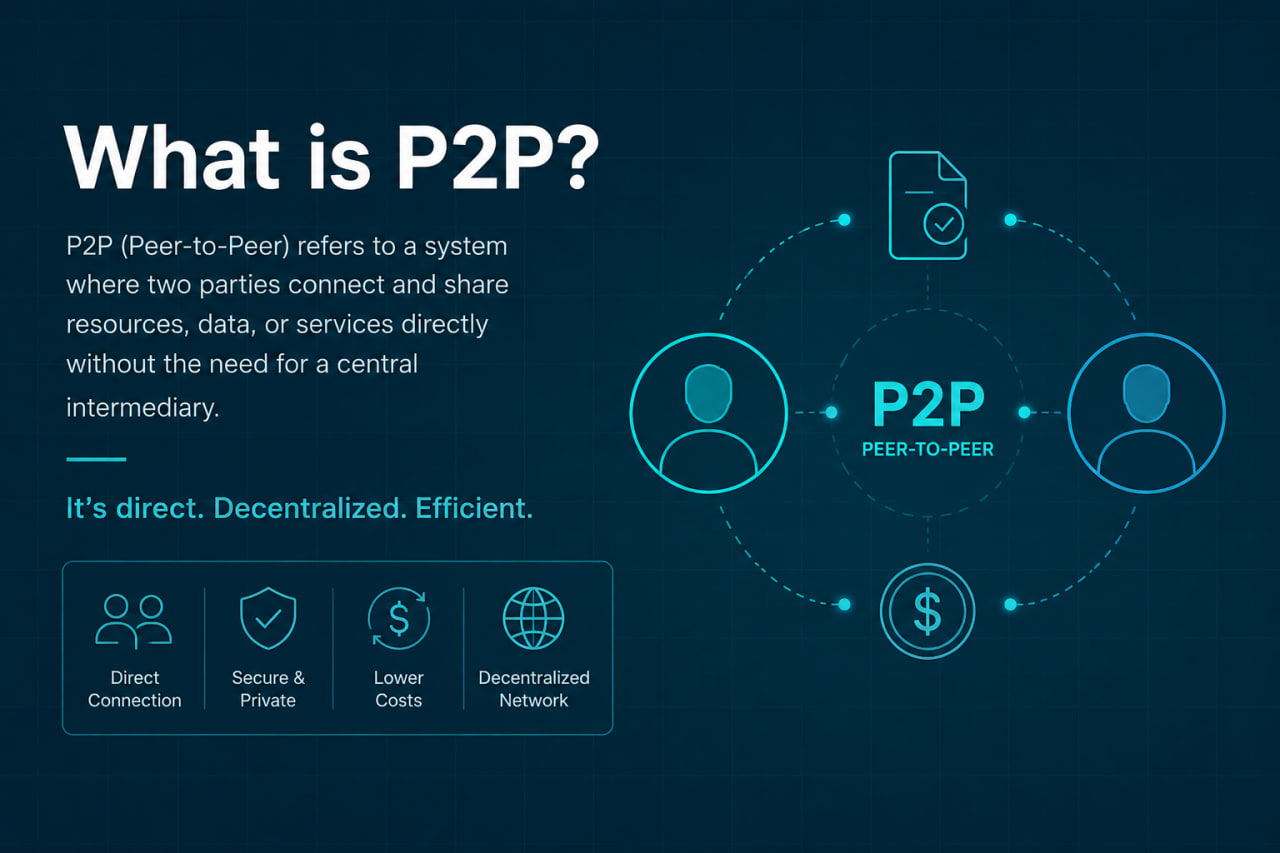
P2P stands for peer-to-peer. A peer is another participant in the same network. In a classic online model, users often connect to one central server. In a P2P model, participants can connect directly and exchange data, value, files, messages, or resources with one another.
This does not always mean there is no platform involved. Many P2P services still use apps, accounts, verification tools, ratings, search systems, payment support, or dispute handling. The important difference is that the core interaction happens between users, not only between a user and one central company.
How P2P Works
A peer-to-peer system lets participants act as both receivers and providers. In file sharing, one user can download a file while also sharing parts of it with others. In P2P payments, one person can send value directly to another person. In a marketplace, a seller can list an offer and a buyer can deal with that seller through the platform.
Good P2P systems usually combine direct interaction with trust tools. These tools may include identity checks, escrow, transaction history, encryption, moderation, ratings, user reports, or clear platform rules. Without those layers, direct exchange can become risky.
Direct Exchange
Users interact with each other instead of sending every action through one central structure.
Shared Resources
Peers can share bandwidth, data, files, liquidity, computing power, or available offers.
Flexible Access
P2P can make digital services easier to scale because many participants support the network.
Trust Layer
Verification, ratings, escrow, and rules help make direct user exchange safer and clearer.
Where P2P Is Used
P2P is not limited to one industry. It appears in many systems where users need to exchange something directly, whether that is information, files, digital value, products, services, or access.
| P2P Area | How It Works | Why It Matters |
|---|---|---|
| File Sharing | Users share parts of files with other users across a network. | It can reduce dependence on one server and improve distribution speed. |
| Payments | One user sends money or value directly to another user. | It can make transfers faster and more convenient. |
| Marketplaces | Buyers and sellers connect through a platform but trade with each other. | It creates more flexible access to products, services, and local offers. |
| Blockchain Networks | Participants help validate, store, or share data across a distributed system. | It reduces reliance on one central controller. |
| Gaming Systems | Players may exchange items, access, value, or data directly inside a platform. | It supports community-driven activity and direct user interaction. |
Why P2P Is Important
P2P is important because it gives users a more active role in digital systems. Instead of only consuming from a central provider, users can also contribute, exchange, share, and support the network. This can make systems more open, more flexible, and sometimes more efficient.
At the same time, P2P does not remove the need for control. A useful P2P platform still needs clear rules, privacy protection, security checks, and simple explanations. The more direct the exchange is, the more important trust becomes.
- Speed: direct exchange can reduce unnecessary steps.
- Access: users can reach other users, offers, files, or services more easily.
- Scalability: some P2P systems grow because participants support the network.
- Resilience: less dependence on one central point can reduce single-point failure.
- Community: users are not only passive visitors; they become part of the system.
Benefits and Risks of P2P
P2P is useful, but it should not be treated as automatically safe. The same directness that makes P2P convenient can also create problems when users are not verified or when platform rules are weak.
Benefit
Faster direct exchange between participants.
Benefit
Lower dependence on one central provider.
Risk
Fake users, scams, unsafe files, or unclear offers.
Risk
Privacy issues and disputes if the platform has weak controls.
Use P2P With Clear Rules
P2P works best when users understand who they are dealing with, how the exchange is protected, what platform rules apply, and what risks should be checked before sending money, files, data, or any form of value.
Start a ConversationFAQ
What is P2P in simple words?
P2P means users connect or exchange directly with other users. Instead of everything going through one central server, participants can share files, data, payments, services, or resources between themselves.
Is P2P the same as decentralization?
Not always. P2P can be part of a decentralized system, but many P2P platforms still use central tools such as accounts, moderation, search, ratings, payment support, or dispute resolution.
Why do people use P2P systems?
People use P2P systems because they can make exchange faster, more direct, and more flexible. P2P can also help users access files, services, markets, payments, or networks without relying fully on one central provider.
What are the main risks of P2P?
The main risks are scams, fake users, unsafe files, privacy issues, unclear rules, and disputes between participants. Strong platforms reduce these risks with verification, ratings, moderation, security checks, and transparent policies.
Where can P2P be found online?
P2P can be found in payment apps, marketplaces, file-sharing networks, blockchain systems, gaming communities, messaging tools, and platforms where users exchange value or information directly.
Final Thoughts
P2P is a practical model for direct digital exchange. It can make systems more flexible, faster, and more user-driven, but it also needs clear rules and responsible use. The best P2P platforms combine direct interaction with trust, security, transparency, and support.